
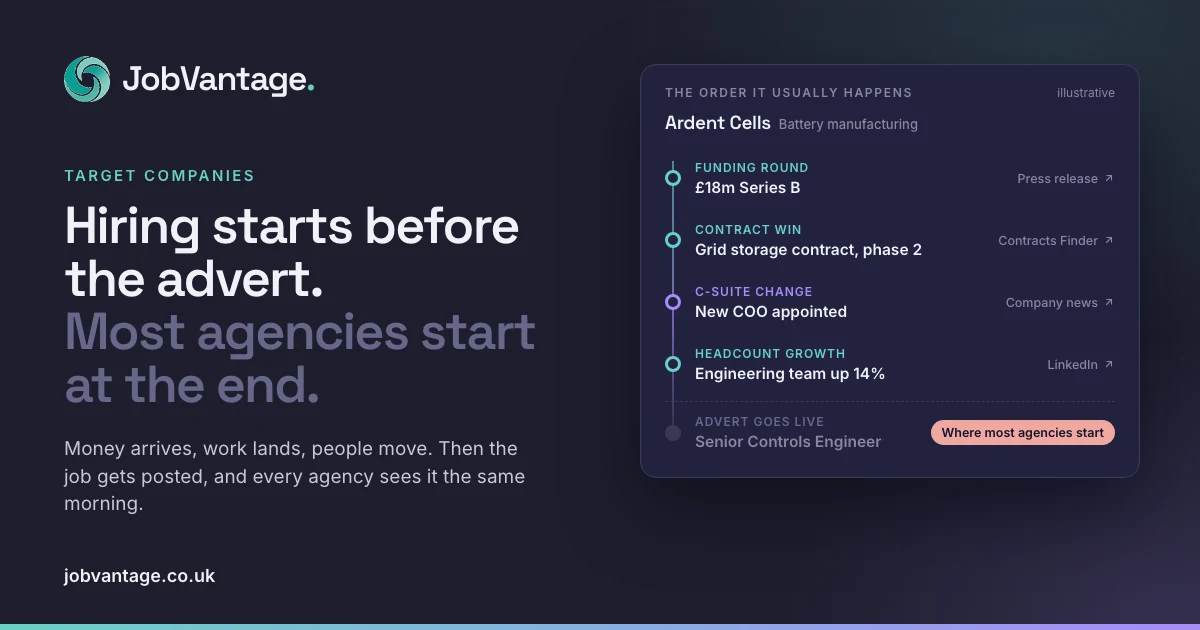
Short answer: Companies usually show they are about to hire before they advertise. Money arrives, through a funding round, a grant or a government scheme. Work lands, through a contract win, an acquisition or a new site. People move, through a new C-suite leader or steady headcount growth in one team. Each of these is public, dated and sourceable. An agency that watches its target list for them can call with a reason before the advert exists, instead of joining the queue after it.
Watch: JobVantage Target Companies in 60 seconds.
Why waiting for the advert costs agencies the role
By the time a job is advertised, three things have usually happened. The company already has a plan to fill it: a referral, a preferred supplier list, a direct campaign. Every agency on that list, and plenty that are not, sees the same advert the same morning. And with several agencies offering overlapping candidates, the fee is usually the first thing to give.
There are also fewer adverts to chase. Indeed's data, published on 15 October 2026, puts UK job postings 11% lower than at the start of the year and 32% below their February 2020 baseline. Graduate postings are down around 13% year on year, the lowest for this point in the year since 2020. In London finance, Morgan McKinley recorded professional vacancies falling 30% between July and September, from 1,719 a month to 1,200.
Fewer adverts is not the same as no hiring. The KPMG and REC Report on Jobs for September showed permanent placements rising for a second month, to their strongest reading in four years, while the vacancies index stayed below 50 at 48.5. Hiring is happening while demand on paper still looks soft. For an agency, that makes the advert a worse place to start: there are fewer of them, and each one is more crowded.
What are the signals that a company is about to hire?
There are twelve signals worth watching, in four groups. None of them is a guarantee on its own. Together, they tell you which companies on your list are moving, and roughly where.
1. Money arriving
Funding rounds, government funding schemes and startup grants. A company that has just raised money has told its investors what it will spend it on, and for most growing businesses that means hiring. In the UK, a new allotment of shares has to be filed at Companies House on an SH01 form, sometimes before the round is announced. Government schemes and grants are published by the bodies that award them.
2. Work landing
Government contracts, public projects, expansion and acquisition. New work has to be delivered by someone. UK public sector contract awards are published on Contracts Finder and Find a Tender, so a supplier that has just won a large contract is on the public record. Dayshape's 2026 study of 400 senior leaders at UK and US professional services firms found that 55% miss, delay or turn down client work because of capacity constraints. A firm that has won more work than it can staff is a hiring signal no job board will show you.
3. People moving
C-suite changes, headcount growth and redundancies. A new COO, CTO or finance director usually reshapes the team below them, and the hires that follow are theirs to make. Steady headcount growth in one function shows where the next roles are likely to land. Redundancies cut both ways: they tell you where strong candidates are about to come from, and sometimes which part of a business is being rebuilt.
4. Said out loud
Company PR posts, press coverage and live vacancies. New offices, product launches and leadership appointments are usually announced by the company itself. Live vacancies count too: the first hire into a new team often comes before several more.
Why one signal is not enough
A single funding round is noise. A funding round, then a new COO, then three months of hiring in operations, is a pattern. The value is in stacking signals on the same company and reading them by role: a battery manufacturer that has just won a grid contract is far more likely to need controls engineers than finance staff.
That is what a hiring heatmap does. It scores each company on your list, role family by role family, out of 100 for the chance it hires in the next 12 months, so each desk's call list sorts itself.
How to track hiring signals across a target company list
You can do this by hand. The method:
- Write the list: the 25 to 250 companies you most want to win, by desk.
- Pick the signals that matter for your niche. Engineering desks lean on contract wins and public projects; tech desks lean on funding rounds and leadership changes.
- Check the sources every week: Companies House, funding news, Contracts Finder and Find a Tender, company newsrooms, the trade press, LinkedIn headcount and each company's careers page.
- Log every signal with its date and a link to the source, so the reason for your call can be checked.
- Find the person who owns the hire: the head of the function, not only the talent team.
- Call with the dated reason and a candidate who fits it.
The method works. The problem is the arithmetic. Twelve signals across 250 companies, checked every week, is a full-time job before anyone picks up the phone, which is why most desks fall back on the job boards.
How JobVantage Target Companies does it
Target Companies gives you a strategic view of the companies you want to win and predicts which are about to hire. You send your list, or we build one from your niche. Every week it checks each company for live vacancies and the twelve signals above, and shows each signal with its source link and date, alongside the named people who own the hire.
From there you can match your A-player candidates to the live roles at those companies, ranked by the requirements each one meets. Suggested Companies brings in businesses in your niche that are starting to move but are not on your list yet. It covers companies globally, so you can map a new market before you expand into it. It works with or without JobVantage matching.
Pricing is per company, not per seat: £2 per company per month for the first 250, £1 from 251 to 1,000, and 50p beyond that, refreshed weekly. One account covers the whole agency. There is a £750 one-off setup fee and a £200 monthly minimum, all ex VAT. A monthly refresh costs half as much; daily costs two and a half times as much.
Try it on 25 of your own companies
Tell us 25 companies you want to win and we will build the first dataset on them for free: live roles, growth signals, decision-makers and lookalike companies, followed by a 20-minute walkthrough. No card, no commitment. Send us your 25 companies.
Frequently asked questions
What is target company monitoring in recruitment?
Target company monitoring means watching a fixed list of companies an agency wants to win for signs they are about to hire, such as funding, contract wins, leadership changes and headcount growth, so the agency can approach them before a role is advertised.
What are hiring signals?
Hiring signals are public, dated events that tend to come before a company recruits: money arriving (funding rounds, grants, government schemes), work landing (contracts, public projects, acquisitions), people moving (C-suite changes, headcount growth, redundancies) and announcements (press coverage, company posts, live vacancies).
How far ahead of the advert do hiring signals appear?
There is no fixed lead time; it varies by signal and sector. Funding and contract wins tend to come first, because the money or the work has to arrive before the roles exist. Treat a signal as a reason to call, not a guarantee of a vacancy.
How is this different from job alerts?
A job alert tells you about a role once it is advertised, at the same moment it tells every other agency. Target company monitoring tells you which companies are likely to hire before that point, with the evidence and the person to contact.
What is speccing?
Speccing is business development where a recruiter approaches an employer with a specific candidate as the reason for the call, rather than asking whether they have vacancies. Hiring signals tell you which employers to spec into, and when.
How much does JobVantage Target Companies cost?
From £2 per company per month for the first 250 companies, falling to £1 and then 50p in bands, with a weekly refresh, a £750 setup fee and a £200 monthly minimum. One account covers the whole agency. Full pricing is on the Target Companies page.
Can I try it before paying?
Yes. Send 25 target companies and we build the first dataset free, then walk you through it on a 20-minute call.
Sources: Indeed UK job postings data, via The Global Recruiter, 15 October 2026. Morgan McKinley London Employment Monitor, Q3 2026, via Onrec, 13 October 2026. KPMG and REC UK Report on Jobs, September 2026, via Onrec, 8 October 2026. Dayshape, Professional services: navigating a new operating era, via Onrec, 13 October 2026.