
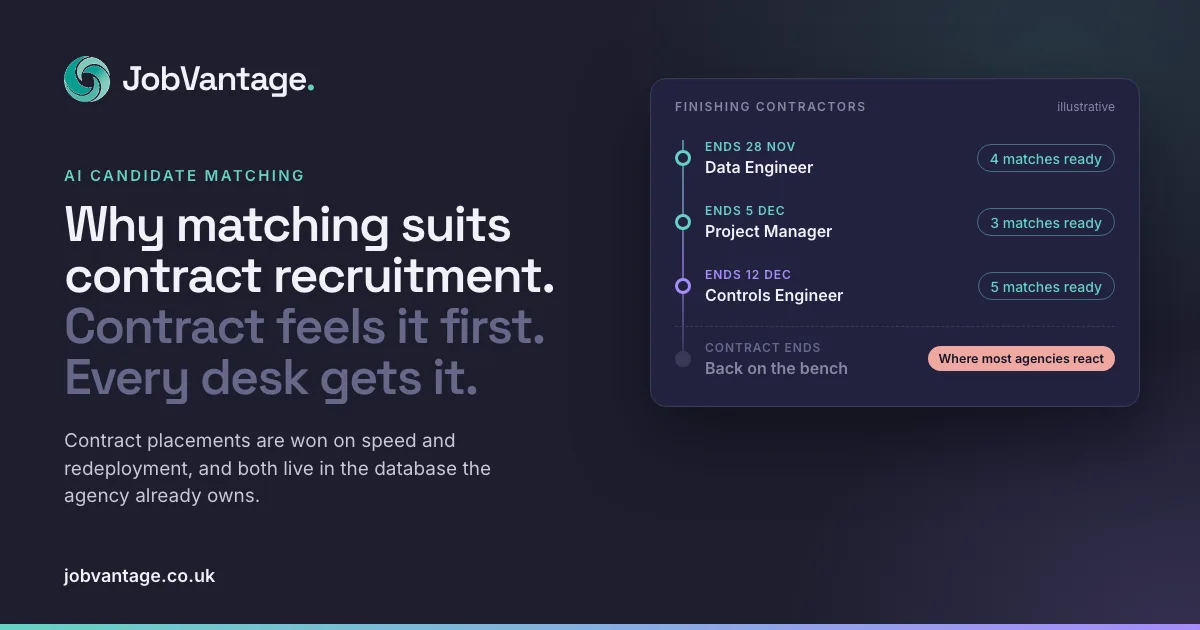
Short answer: contract recruitment is won on speed and redeployment, and both depend on the candidate database the agency already owns. AI matching takes a live role and returns ranked, explained matches from that database, or takes a candidate and returns the live roles they fit. That compresses hours of searching into minutes, and it matters most where turnaround is shortest. Contract desks feel the benefit first, but the mechanism is the same for permanent desks and in-house teams: no database is short of good candidates. It is short of a fast way to connect them to live demand.
The contract desk's real asset is its database
A permanent placement ends the relationship for years. A contract placement starts a cycle: the contractor finishes in three, six or twelve months and comes back to the market on a date the agency already knows. A contract database is not an archive of old CVs. It is a bench of people who will be available again, with track records the agency itself delivered.
Redeployment is the cheapest revenue in recruitment. No advert, no sourcing spend, no cold approach: the candidate is known, referenced and warm. What loses it is time. Miss a contractor's end date by a week and another agency places them, and the relationship built over previous assignments goes with them.
This is where matching changes the economics. Instead of a consultant remembering who is finishing and manually trawling live roles, each finishing contractor can be run against every current requirement, ranked with written reasons, before they ever sit on the bench.
Speed decides contract placements
A permanent process runs over weeks, so a shortlist that takes a day is survivable. A contract client often needs someone to start within days, and the first credible CV usually wins the role. The race is not about who has the best candidate somewhere in their system. It is about who finds them first.
In partner testing during 2026, shortlisting with JobVantage ran 24x faster than the same work done by hand, and the full journey from CV to spec email took 17 minutes. On a permanent desk that is efficiency. On a contract desk it is the difference between winning the role and reading about it.
Margins are under new pressure
Since 6 April 2026, UK recruitment agencies are jointly and severally liable for PAYE on payments made through umbrella companies in their supply chain. HMRC can pursue the agency for an umbrella's unpaid tax regardless of intent. For contract agencies that means more due diligence, more compliance overhead and thinner effective margins per placement.
When the cost of running a contract placement goes up, the cost of finding the candidate has to come down. Filling from a database you already own, rather than paying to source someone new, is the cheapest fill available, and matching is what makes that fill reliable rather than dependent on one consultant's memory.
The market is moving contract's way
Through 2026, UK employers have favoured flexibility. Temporary billings grew from spring into autumn, with June recording the fastest growth since April 2023, while permanent placements fell for most of the year. The November 2026 Report on Jobs showed temp billings dipping marginally below neutral in October, but the year's pattern is clear: when employers hesitate on permanent headcount, contract demand holds up better. Meanwhile the ONS's November 2026 release put UK vacancies at 690,000 for August to October 2026, the lowest outside the pandemic since 2014, which rewards precision over volume on every desk. Our read of the November 2026 layoffs covers where that pressure lands.
Permanent desks and in-house teams: same mechanism, different cadence
The argument is not contract-only. It is that contract feels it first because the cycle is faster.
A permanent desk's database holds candidates who registered months ago, interviewed well for roles that fell through, or were the second choice on a completed search. Every new brief should run against that database before any sourcing starts, because a placed candidate who was already in the system costs a fraction of one found from scratch.
In-house teams sit on the same opportunity. Past applicants and interview runners-up stay in the ATS while the company pays job boards to meet them again. Matching an open requisition against the existing applicant pool is the lowest-cost channel most talent teams never systematically use.
Where JobVantage fits
JobVantage is an AI intelligence layer for recruitment. It sits on top of an existing ATS or CRM and is ATS-agnostic. Upload candidates and it returns the live roles each one fits, with every match scored and explained, including the specific requirements met and the ones missed. Upload a role and it returns ranked candidates from your own database with the same written reasoning. From the same screen it finds decision-makers and drafts the outreach.
A match is a match whether the role is a six-month contract or a permanent hire. The difference is cadence, and contract cadence is where fast, explained matching pays back soonest. If you want to see it on one of your own candidates, book a demo and we will run it with you on the call.
Frequently asked questions
Is AI candidate matching suitable for contract recruitment?
Yes, and arguably more so than for permanent recruitment. Contract roles fill in days, contractors return to the market on known dates, and redeployment from an existing database is the cheapest placement an agency can make. Fast, explained matching against live roles directly supports all three.
Why does redeployment matter so much to contract agencies?
A contractor the agency has placed before is known, referenced and already on the database, so redeploying them carries no advert or sourcing cost. The main reason redeployment fails is slow reaction to end dates, which is a matching and visibility problem rather than a sourcing one.
What changed for UK contract recruitment agencies in April 2026?
From 6 April 2026, agencies became jointly and severally liable for PAYE on payments routed through umbrella companies in their labour supply chain. HMRC can recover an umbrella's unpaid tax from the agency, which raises compliance overhead and squeezes contract margins.
Is the UK temporary staffing market growing in 2026?
It grew from spring to autumn 2026, with June's temp billings rising at the fastest rate since April 2023, before dipping marginally below neutral in October. Across the year, temporary demand has held up better than permanent hiring, which fell for most of 2026.
Is JobVantage a contract recruitment tool?
No. JobVantage is an AI matching layer for recruitment generally: permanent desks and in-house teams run the same candidate-to-role and role-to-candidate matching, with the same scored and explained output. Contract recruitment is simply where the speed and redeployment benefits show up first.
Can in-house recruitment teams use database-to-role matching?
Yes. The same mechanism applies to a company's ATS: matching open requisitions against past applicants and previous interviewees surfaces candidates the company already knows before it pays to advertise for new ones.